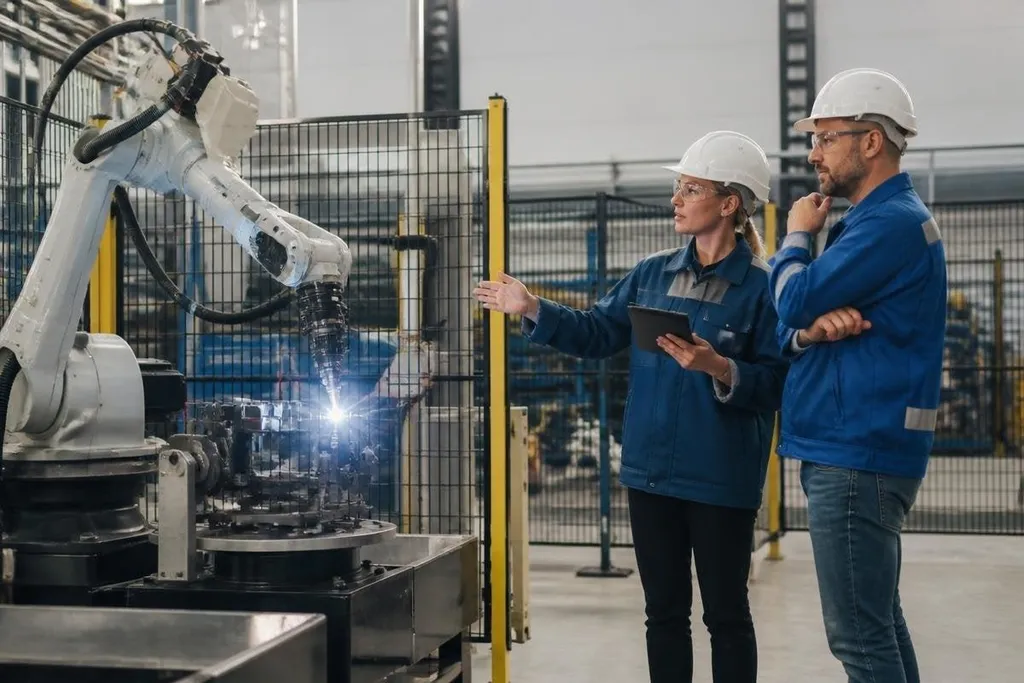
An industrial robot can weld the same joint, move a pallet, or load a machine for hours. The gain comes from repeatable motion, while the risks come from speed, stored energy, poor guarding, and weak work planning.
For a plant manager weighing automation, the useful question is practical: which task should the robot take, and what must change around it?
- Robots repeat fixed motions without tiring.
- Guards, scanners, and training control contact risks.
- Maintenance, integration, and downtime shape the real cost.
Where robots help
Robots work best when a task has a clear start point, a clear finish point, and little variation. Welding, painting, palletizing, machine tending, and part inspection fit that pattern because the robot can follow a planned path or place parts at known locations.
The arm also keeps people away from heat, fumes, sharp edges, and heavy parts. Its end effector, the tool fixed to the arm, can hold a gripper, welding torch, suction cup, or paint sprayer. Changing that tool changes the job without rebuilding the whole cell.
Repeatability matters when a process needs the same position each cycle. The controller sends joint motors through set angles, while sensors check position and movement. That consistency can reduce variation in a weld or keep parts in the same place for the next machine.
The benefit has a limit. Programmed motion doesn't understand a damaged box or a part placed several centimeters away unless the cell has sensors and software for that case.
Where the risks start
The arm can move fast, and its load can keep moving after the motor stops. A dropped part, a sharp tool, or a loose cable can injure someone inside the work area. The risk rises when staff enter a cell to clear jams, inspect parts, or fix a fault.
Safety controls need several layers. A physical guard blocks entry during automatic operation. An interlock stops the cell when a gate opens.
A safety scanner can detect a person near an open area and send a stop signal. An emergency stop gives staff a direct way to halt motion.
These parts work only when the plant sets them up for the real task. A scanner placed behind a pallet cannot detect a person in front of the arm. A gate that workers can reach around has a design problem, even if the control panel shows a green light.
The main safety standards include ISO 10218 for industrial robot systems and ISO/TS 15066 for collaborative robot applications. The standard that fits depends on the robot, the task, the tools, and the way people share the work area.
The cost beyond the robot
The arm is one part of a larger cell. You may also need a fixture, gripper, controller, guarding, safety devices, wiring, programming, staff training, and changes to the floor layout. Those parts affect the budget and the time needed to start production.
Downtime also needs a place in the plan. A robot cell can stop when a sensor fails, a tool wears out, a part shifts, or a program meets an object it wasn't built to handle. Spare parts and a trained person on each shift can reduce the length of that stop, but they add cost.
A repair plan can decide whether a robot saves money after the first fault. Reports from Robot 24 can connect a factory deployment with its machine, task, and service needs, so you can judge whether the system still fits when production changes.
I'd skip automation when the task changes every few seconds and no one has mapped those changes. The system may still work there, but the sensing, software, and service burden can cost more than the task saves.
A safer buying decision
Use this check before signing a robot order:
- Name the task: record the part, tool, cycle, shift length, and handoff point.
- Map human entry: mark every reason a person enters the cell and how often it happens.
- Set the safety design: choose guards, interlocks, scanners, and stop controls with a qualified safety engineer.
- Test bad inputs: run bent parts, empty fixtures, sensor faults, power loss, and blocked paths.
- Price the support: include training, spare tools, service time, software changes, and planned downtime.
- Set a review date: compare cycle time, stoppages, defects, and safety events after launch.
A good first task has stable inputs, a measurable cycle, and a safe way to recover from faults. If those conditions are missing, fix the process before buying the arm; the next decision should follow the failure data, not the sales demo.